FULL-BODY CARDIO IN LIMITED SPACE
Collection:
Rowers
Show more Show less
A rowing machine adds a different movement to home cardio, with each stroke involving your legs, body and arms. WalkingPad's rower collection includes the WR20 water rower and WM10, which combines water and magnetic resistance. Compare how the resistance is adjusted, along with the seat travel and working dimensions. The folding format also matters when the room is shared with everyday activities. Check the space needed for a full stroke and the storage instructions before deciding which rower belongs in your home.

SAFE STORAGE
No risk of tipping

TRIPLE FOLD
Folds to save space

TOTAL BODY
Full-body cardio

JOINT FRIENDLY
Low impact & big results
SAFETY IS THE NEW SEXY
Rowing is a safe and effective full-body cardio workout that delivers great conditioning with low joint impact. Our folding rowing machine makes it easy to exercise at home anytime. No other rower is as safe or as easy to use as a KingSmith triple-fold rower.

WR20 TRIFOLD™ ROWER
Flagship folding water rower for elite-level full-body training

WM10 TRIFOLD™ ROWER
Water & magnetic rower with quick adjustment, for your whole family

WR3L TRIFOLD™ ROWER
Affordable water rower that can transform into a side table
AWARD-WINNING DESIGN
Our foldable treadmills and benches have earned global design awards for their innovative space-saving folding design, refined aesthetics, advanced manufacturing, and user-friendly functionality.

Red Dot Design Award for 2019, 2022, 2026

IF Design Award for 2019, 2022, 2026

Good Design Award for 2020
EXPLORE OTHER PRODUCTS


Just Walk Series
Flat fold walking pads that can help you walk at ease and store under bed / sofa.
WE MAKE IT EASY

Free Shipping
Free CA shipping on orders ≥$300

1-Year Warranty
1-year warranty with optional extension available.

15 Day Price Match
Price guarantee within 15 days after your purchase.

30-Day Returns
Easy returns and repairs within 30 days.
Conversion helper
Need Help? We're Here.
Here are the most common questions our customers have asked. Still have questions? Contact our customer support.
Is rowing a better choice than a treadmill if my knees are the problem?
It can be, particularly compared with running, because rowing is a low-impact activity. Your feet stay strapped to the footplates and there is no repeated landing impact, unlike running, where each footfall places additional stress on the knees. The WM10 and WR20 support up to 331 lb (150 kg), while the WR3L supports up to 400 lb (181 kg), and because your weight is supported by the seat rather than through repeated footfalls, rowing can be a more comfortable option for some people with knee concerns.
Two conditions on that. First, technique: knee discomfort on a rower can sometimes result from over-compressing at the catch, where the shins pass beyond vertical and the knee closes too far. Set the footplate so the strap crosses the ball of your foot, and stop the slide when your shins reach vertical. Second, scope: rowing can provide a cardiovascular workout with less impact than running, but it is not a rehabilitation programme. If you have an existing knee condition, are post-surgery, or have been told to avoid loaded knee flexion, ask your physiotherapist before starting — that is a clinical decision, not a purchase one.
How do I clean and maintain a water rower — does the water go bad?
Maintenance is minimal, but the water does need attention. The tank is designed to prevent leaks, but algae can develop over time, particularly in warm conditions. The fix is to use a suitable water purification tablet as recommended in your model's instructions, following the specified dosage and maintenance schedule. Follow the instructions for filling and replacing the water when needed. Beyond that: wipe the seat rail after every session to keep the seat moving smoothly; wipe the handle and footplates; and check the footstrap stitching periodically.
One point that matters in Canada specifically: avoid storing a water rower anywhere temperatures could fall below freezing, including an unheated garage, a three-season room or an uninsulated basement over winter. Water expands when it freezes, and this can damage the tank. Keep it in a temperature-controlled indoor space. A common misconception worth correcting: water level can affect resistance, but you can also adjust workout intensity through stroke rate and force, and — on the WM10 — the magnetic resistance dial.
What does a rowing machine work, and is it really a full-body workout?
It is, and the ratio is the part most people get wrong: a rowing stroke is roughly 60% legs, 30% body and 10% arms in terms of power contribution. Getting that sequence right — legs, then hip hinge, then arms on the drive, reversed on the recovery — helps you row efficiently while reducing unnecessary strain on your lower back. Worked properly you train quadriceps, glutes and hamstrings on the drive; lats, rhomboids, traps and spinal erectors through the body swing and pull; biceps and forearms at the finish; and the abdominals and obliques continuously as the link between the two. That combination makes it an effective full-body workout that strengthens your legs, back and core while staying low-impact, since your feet never leave the footplates.
Two buying implications follow. Rail length matters, because a rail that is too short forces a shortened leg drive and can make it harder to maintain proper technique; check that the machine provides enough room for your height and supports your weight. And good technique matters, so use the first two or three sessions to learn the sequence at a low rate rather than training hard.
WM10 or WR20 — how do I choose between your two rowers?
They are aimed at different priorities and the cheaper one has more adjustability, so it's worth looking beyond the price. The WM10 ($699) combines water and magnetic resistance, delivering up to 110 lb (50 kg) of pulling force, with a DigitalDial knob that changes resistance with a twist. That adjustability is what makes it right for households where people of different strengths share the machine, and for interval sessions where you want to adjust the resistance rather than rely only on your effort. It folds to about 3.8 ft² (0.35 m²) of floor space and arrives fully assembled.
The WR20 ($849) uses a vertical water resistance system built for higher resistance and a more authentic, self-scaling feel, delivering up to 176 lb (80 kg) of resistance. It folds into a stable 28.94 × 18.90 × 22.83" (735 × 480 × 580 mm) block smaller than most dining chairs, and supports up to 331 lb (150 kg). Choose the WM10 for shared use and adjustability; choose the WR20 for a stronger pure-water rowing experience and a higher maximum resistance.
A rower is over two metres long. Where does it go in a condo?
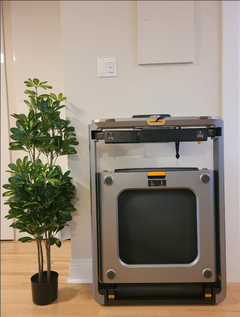
That is one reason people hesitate to buy a rowing machine, and the TRIFOLD™ design is the specific answer. Unfolded you need the full rail for a proper leg drive; folded, the WM10 measures 28.94 × 18.9 × 22.83" (735 × 480 × 580 mm), and the WR20 folds to the same compact dimensions, taking up less floor space than many dining chairs. Both are designed for quick, convenient folding, making it easier to put your rower away after each workout rather than leave it in the living room.
The second design point is stability: these fold into a compact, stable shape that rests on the floor, rather than standing on end, making them easier to store securely around the home. In a Canadian condo, you can store a folded rower next to a wall or in an unused corner of the room.
Is 20 minutes on a rowing machine a good workout?
Yes, and rowing can provide an effective full-body workout in a relatively short time — which is exactly why it suits people short on time rather than short on motivation. Twenty minutes of continuous rowing works the legs, back, core and arms simultaneously while remaining low-impact. A workable structure: five minutes easy while your technique settles, twelve minutes of steady work at a pace where you can still speak in short sentences, three minutes easy to finish. Three or four of those a week can help improve aerobic fitness and strengthen the muscles used in rowing over time.
Where twenty minutes may be too much is when you're still learning the technique — start with shorter, slower sessions, because a rushed, back-led stroke learned early can lead to poor habits and back discomfort. Two markers to judge yourself by rather than watching the clock: try around 20–26 strokes per minute as a starting point rather than as many as possible, since rowing is about force per stroke, not just frequency; and if your lower back tires before your legs do, check your technique — the legs must drive before the body swings. Both machines here support the free KS Fit app for workout tracking and Kinomap for interactive rowing experiences.