WALKINGPAD TREADMILLS
Collection:
WalkingPad Foldable Classic Treadmills
Show more Show less
The Foldable Classic series combines a familiar treadmill layout with folding storage for a room that has other uses. This collection features the G1 format, with product details that help you compare its running setup, controls and space requirements. Think about where you will exercise and where the folded machine will rest afterwards. Check the stated dimensions rather than assuming it will fit beneath particular furniture. Your normal pace, stride and storage space are useful starting points for choosing a home treadmill.

FOLDABLE
Store laying flat

Convenient
Easy to use

COMPACT
Save space

SPEED
Walk & jog
PIONEERING TECH MEETS COLORFUL DESIGN
The Foldable Classic Series features our pioneering collapsible design, paired with vibrant colors and versatile speeds for walk, jog, and run workouts. Traditional form with a minimal footprint to keep your space just as you want.

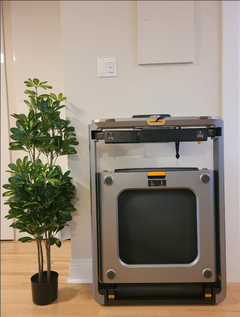
G1 TREADMILL
Traditional tread design wiith fold up technology to roll out of the way
AWARD-WINNING DESIGN
Our foldable treadmills and benches have earned global design awards for their innovative space-saving folding design, refined aesthetics, advanced manufacturing, and user-friendly functionality.

Red Dot Design Award for 2019, 2022, 2026

IF Design Award for 2019, 2022, 2026

Good Design Award for 2020
EXPLORE OTHER PRODUCTS


Just Walk Series
Flat fold walking pads that can help you walk at ease and store under bed / sofa.

we make it easy

Free Shipping
Free CA shipping on orders ≥$300

1-Year Warranty
1-year warranty with optional extension available.

15 Day Price Match
Price guarantee within 15 days after your purchase.

30-Day Returns
Easy returns and repairs within 30 days.
Conversion helper
Need Help? We're Here
Here are the most common questions our customers have asked. Still have questions?
Contact our customer support.
Is the G1 suitable for an older parent who wants to walk indoors?
It can be a practical option in the range for indoor walking, and one reason is the side armrests: support sits where the hands naturally fall rather than requiring a forward reach, which can help a less confident walker feel more secure. It arrives fully assembled, so there is nothing to build, and it folds flat through 180 degrees so it can be put away between uses rather than dominating a room. Speed is controlled by a SpeedDial™ knob, which provides a straightforward physical control rather than requiring an app — though the free KS Fit is there if they prefer it.
Practical setup advice can matter as much as the specification: leave clear floor space around the treadmill, begin at a slow, comfortable walking pace and only increase the speed once they feel confident and steady, and have someone present for the first few sessions if needed. If balance is significantly impaired, or there is a history of falls, dizziness or recent surgery, check with their physician or physiotherapist before starting.
What is a folding running machine, and how is it different from a walking pad?
A folding running machine is built to support faster workouts while giving you a way to reduce its footprint after exercise. Compared with walking pads made primarily for everyday or under-desk walking, it typically offers a higher maximum speed, a more supportive frame and handrails for added stability during jogging or running. Many walking pads, by contrast, prioritise a lower profile and easier storage, with speeds suited mainly to walking. The G1 combines a foldable running deck with side handrails, making it better suited to walking, jogging and running while still reducing the space it takes up when stored. Choose a folding running machine if you want higher running speeds and additional support. If your priority is under-desk walking, lower-speed exercise and compact storage, a walking pad may be the better fit.
Why does a running treadmill need side armrests — is that not what the front handrail is for?
Front and side handrails can provide support in different positions. A front handrail gives you a support point in front of your body, while side armrests let you briefly reach for support closer to your sides. This can be useful when adjusting your speed, regaining your balance or getting on and off the treadmill.
The G1 features foldable side armrests for additional support during faster sessions. Its running deck folds 180 degrees for more compact storage, and the treadmill weighs 81.57 lb (37 kg). It arrives fully assembled and also supports KS Fit and Kinomap, with a SpeedDial™ for convenient speed adjustment
How does a 180-degree half-fold work, and does folding it daily wear it out?
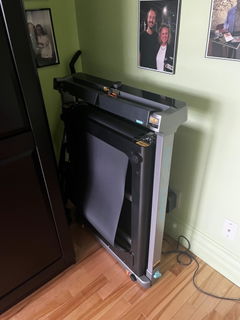
The deck hinges through 180 degrees so the running surface lies flat against the base, taking the machine from a full-length footprint to a compact folded shape you can store against a wall or under furniture with enough clearance. Daily folding should not be a concern when the folding mechanism is used correctly. When the machine is unfolded and locked for use, the deck is supported by the frame, while the hinge primarily allows the deck to fold for storage.
What can cause unnecessary wear on any folding machine is improper handling, such as folding while the belt is still coasting or dropping the deck rather than lowering it carefully. So make two habits part of your routine: stop the belt, wait until it has come to a complete stop, then fold with a hand on the deck. The G1 rolls on transport wheels once folded, so you can fold and wheel it rather than lift the entire 81.57 lb (37 kg) machine. When storing it, make sure it is on a firm, level surface with enough clearance for the folded machine.
Is a folding treadmill quiet enough to use early in the morning in a shared home?
The machine itself can be relatively quiet, particularly on models with brushless motors designed to reduce operating noise. What is audible in a shared home is often not just the motor. It is three other things, in order of how much they matter. Footfall through the floor structure — running transmits far more vibration than walking, and a mat under the frame can help reduce it, particularly in a wood-frame house where joists can carry sound between storeys. The belt and deck if the machine is overdue for lubrication, which can produce a dragging or grabbing sound that is easy to mistake for a fault. And the fold mechanism if you fold it before the belt has fully stopped.
Practical guidance for a 6am session in a house with sleepers: use a mat, walk or jog rather than sprint, keep the machine away from a bedroom-adjacent wall where possible, and lubricate it on schedule. If early sessions are the main use case and someone sleeps below, a walking-focused machine may be a better fit than a running one.