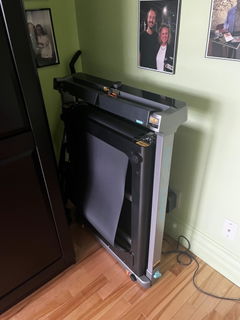
WALKINGPAD TREADMILLS
Collection:
WalkingPad Just Walk Treadmills
Show more Show less
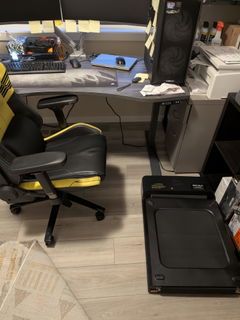
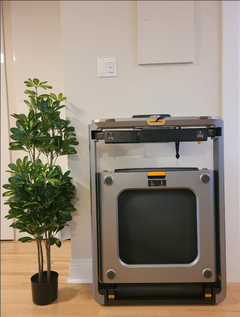
Just Walk keeps the choice centred on daily steps. WalkingPad models in this series are intended for walking at home, with compact formats that can suit a living room or a compatible standing-desk setup. Compare the walking area, controls and user weight limit before choosing a model. Think about how often you will bring it out and where it will go afterwards. Check the folded dimensions and the recommended operating clearance, then set a pace that fits the session you have planned.

FOLDABLE
Fits almost anywhere

CONCENTRATION
Hack your work day

COMPACT
Save space

SPEED
Walk
DAILY MOVEMENT MADE SIMPLE
Walking, as the most common form of exercise, is widely loved by people worldwide. A walking pad treadmill allows you to enjoy the pleasure of walking at home or the office.

R3 WALKINGPAD
Our biggest and best office treadmill with plenty of room to move


AWARD-WINNING DESIGN
Our foldable treadmills and benches have earned global design awards for their innovative space-saving folding design, refined aesthetics, advanced manufacturing, and user-friendly functionality.

Red Dot Design Award for 2019, 2022, 2026

IF Design Award for 2019, 2022, 2026

Good Design Award for 2020
WHICH MODEL IS RIGHT FOR YOU?
EXPLORE OTHER PRODUCTS


we make it easy

FREE SHIPPING
Free CA shipping on orders ≥$300

1-YEAR WARRANTY
1-year warranty with optional extension available

15 Day Price Match
Price guarantee within 15 days after your purchase.

30-DAY RETURNS
Easy returns and repairs within 30 days
Conversion helper
Need Help? We're Here.
Here are the most common questions our customers have asked. Still have questions? Contact our customer support.
How much headroom should I leave above my own weight when choosing?
The ratings in this collection run from 220 lb (100 kg) on models such as the C2 and P1 to 330 lb (150 kg) on the R3. What the number means matters more than the number itself: it is not necessarily a failure threshold but the maximum weight the walking pad is designed to support during normal use. Using a walking pad near its weight limit may put more strain on its components, but it does not necessarily mean the machine will wear out faster. That is why choosing a model with some extra weight capacity can be helpful — a 100 kg person is within a 242 lb (110 kg) rating but may prefer the extra capacity of the A1 Pro's 300 lb (136 kg) version.
Three related points. If you are near the weight limit, follow the operating instructions and avoid exceeding the stated capacity. If two adults of very different weights share the machine, buy for the heavier one — exceeding the weight limit may increase wear or cause damage. And if you want a more affordable option, the H1 in the Hybrid collection is $349 and supports up to 243 lb (110 kg) with a 2.0 Peak HP motor.
Z1, P1, Z1R, C2, A1 Pro or R3 — which one should I buy?
Sort by budget, then by the one feature that differs. At $399 the Z1 is the value anchor: 23 kg, the lightest here, folding into 0.16 m², an ultra-quiet brushless motor below 65 dB. At $409–$449, you choose between the P1 ($449, 28 kg, FootSense™) and the Z1R ($459, 26.2 kg, 242 lb (110 kg) capacity, a removable safety handrail, a folded thickness of 5.5" (140 mm) and an upgraded 8 km/h top speed — the fastest walking-focused model here). At $499 the C2 adds a 5.4" (136 mm) fold designed for under-furniture storage and FootSense™.
At $549 the A1 Pro is the capacity choice, offered in a 300 lb (136 kg) configuration. At $559 the R3 adds light-based progress feedback and FootSense™. Shortest answer: Z1 for value, Z1R for support and speed, A1 Pro for capacity, P1 for slim storage.
Is walking at 6 km/h or less enough exercise to make a difference?
Yes, because what matters is both accumulated activity and intensity. Canadian guidelines call for at least 150 minutes of moderate-to-vigorous aerobic activity a week, and brisk walking can fall within that range, depending on your pace and fitness level — the guidance explicitly allows you to accumulate it in bouts rather than in single sessions, which is exactly what an under-desk machine is good at. At 4–5 km/h, walking burns calories, although the amount depends on body weight, pace and duration, and just as importantly you are breaking up sitting time, which is associated with poorer health outcomes independently of whether you exercise separately.
The honest limitation: walking at a fixed pace may become less challenging as your fitness improves, because you cannot easily increase the load on a flat deck. Your options then are more time, a faster pace up to the model's ceiling, or a machine with more speed range. But for the person currently sitting eight hours and walking 3,000 steps, gradually increasing daily steps can make a meaningful difference, and may be more sustainable than a running programme competing with a workday. Start with 20 minutes twice a day rather than an hour at once.
Is a walking pad without a handrail safe?
For walking speeds, the absence of a handrail is a space-saving design choice rather than an omission, and a walking pad without a handrail can be suitable for people who have good balance and can walk comfortably without support. Speed control is also important: FootSense™ on the R3, A1 Pro, C2 and P1 adjusts the walking speed according to your position on the belt in automatic mode, so you slow down by stepping back rather than by finding a button, and every model here includes a remote. Deck height is low, so stepping on and off is relatively easy, although care is still needed.
Where a handrail genuinely matters: balance impairment, dizziness, recovery from injury or surgery, or anyone who would not comfortably walk unaided outdoors. For anyone who can safely use a walking pad but prefers additional support, the Z1R includes a removable handrail — you can use it with the handrail attached for added stability or remove it when you prefer an open walking surface. Whatever the model, start at 1–2 km/h, keep the remote within reach, and leave clear floor behind you rather than a wall.
Which model actually fits under a bed or a couch?
Measure your clearance first, then match it — this is the specification that decides whether the machine gets used or leans against a wall. The slimmest folded models in this collection are the Z1R, which folds to 5.5" (140 mm), and the C2, which folds to 5.4" (136 mm) and is specifically designed to slide under a bed, couch or desk. Clearance varies by furniture design, so both may fit under furniture with sufficient space — but take the measurement at the centre of the couch rather than at the legs, since many frames sit lower in the middle, and subtract carpet pile.
Then check two dimensions people forget: the folded length must clear the depth of the gap you are sliding into, and the folded width must clear the space between couch legs or bed supports. Weight decides whether you will actually do it daily rather than once: the Z1 at 23 kg, C2 at 25 kg, Z1R at 26.2 kg, P1 at 28 kg, A1 Pro at 28.5 kg and R3 at 30.1 kg. If you plan to store it after every session, the lighter end of that list is where to look.
My home office is carpeted. Will that cause problems?
It can, particularly with thick or soft carpet. Ventilation: the motor housing on a slim pad sits close to the floor, and deep pile or a thick underpad may restrict ventilation and allow dust to accumulate around the machine. On carpet, place a firm, suitable treadmill mat underneath and vacuum around and under the unit monthly. Stability: soft carpet can cause the frame to sit unevenly, potentially affecting belt tracking and automatic speed sensing. A firm mat may help provide a more stable surface, but it should not be too soft or interfere with the sensors. Check the belt alignment regularly and adjust it if necessary.
Three further points: the walking surface may feel less stable on soft carpet; check belt alignment after the first week, especially if the machine shifts during use; and keep the machine and the surrounding floor dry during use and storage.